
Start Here
In the early 2010s, I was fresh out of high school and still figuring it out on my own. If I could sit that version of me down, I'd tell him one thing first: losing weight and keeping it off are two different jobs. Keeping it off comes down to mindset, consistency and priorities.
Think of it like cleaning your house. Anyone can do one big weekend clean. Keeping it clean takes small habits every day that nobody claps for. Most people are great at the big clean. Very few build the habits.
Back then, I knew how to work hard. What I didn't fully understand yet was what I was willing to give up, and what I wasn't.
Your First Step: Write down your priority right now: strength, weight loss or recomp. Then write one thing you're willing to sacrifice to get it, and one thing you're not. Date it and keep it where you'll see it.
The Breakdown
Why I Started Writing Things Down
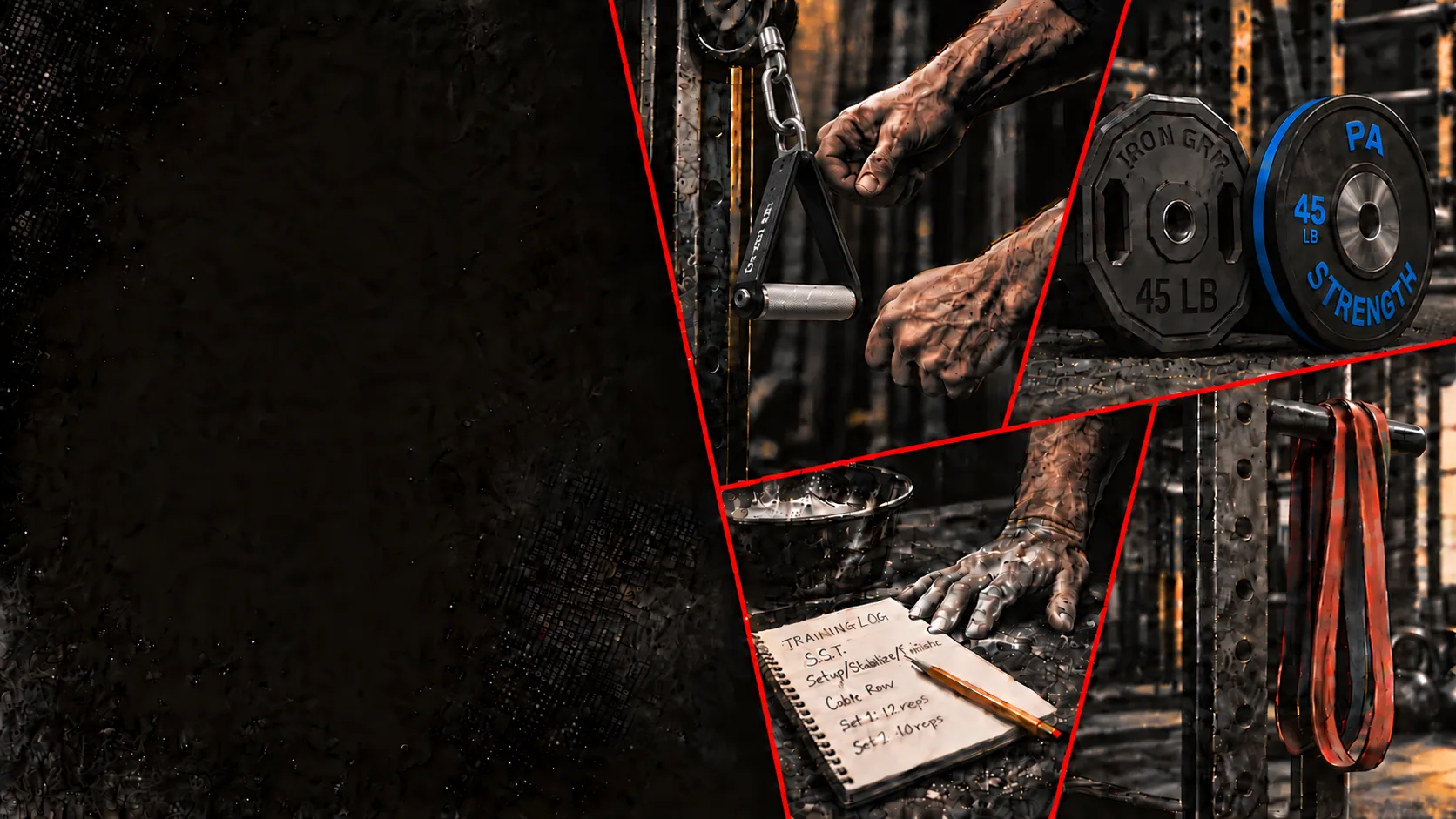
Around the end of high school, I started recording what was going on with me. A lot of it was handwritten notes. Some of it was a blog where I vented. I was tired, I was frustrated, and I was writing it out.
None of it was polished. It wasn't meant to be. It started as a way to be more accountable and to get myself in the right mindset. It was an outlet outside of the gym.
I still do it today. The format has changed. The reason hasn't.
Where I Was in the Early 2010s
After high school, I peaked near 420 pounds. My first cut started that summer and carried into my first year of college. I crash-dieted on my own and started rebuilding at community college, earning transfer credits so I could move on to a university. The cut continued there, and further on as I added my second degree.
From there, I transferred to a university. I graduated with two degrees, one in Criminal Justice and one in Exercise Science.
I hadn't started coaching yet. Back then, the only client I had was me.
What College Actually Looked Like
When I transferred, I was about 270 pounds. I was happy, but it wasn't great. My first semester, I went up to about 285. Over that first break, I brought myself back down to about 265.
My goal then was to put on size and lose body fat, because I wanted to keep my strength. That hasn't changed much.
My eating was a lot more consistent during the school year, because I could time my food around my classes. I let myself have food-truck meals twice a week. I wasn't going out, I wasn't drinking, and I didn't go to parties. That wasn't my thing.
My workouts were in the rec center, about two hours at a time. If your schedule is tighter than mine was, read Training on a Busy Schedule.
The college rec center was also my first coaching job. It began with my internship, and I stuck around after. Working with special populations is what got me up at dawn. I had the keys, so I could lift alone for 20 to 30 minutes before opening. After a few months the novelty wore off, because people left equipment out knowing someone else would put it back.
The Walking I Didn't Plan
The biggest reason I lost weight in college wasn't a program. It was walking.
I had a 2010 Tacoma that I was babying. I always parked on the far side of campus so it wouldn't get dinged. Nobody parked over there. That meant extra steps every single day.
Between that and getting around campus, I was walking about 7 miles a day. It didn't bother me. That walking is what let me lose weight and stay cardio-healthy, more than anything else I did that year.
Daily movement adds up in a way one hard workout can't. I still build my day around it.
Bro Science Check: "Cut as hard and as fast as you can. Once the weight is off, it stays off."
What the Research Says: A study followed 14 contestants from a televised weight-loss competition. They lost an average of about 128 pounds (58 kg) in 30 weeks. Six years later they had regained about 90 pounds (41 kg) on average, and their resting metabolism was still about 700 calories a day lower than when they started (Fothergill et al., 2016). Extreme cases, but the lesson holds: fast loss without a long-term plan is hard to keep.
Verdict: Cut. Getting the weight off is half the job. Keeping it off takes habits you can live with.
What I'd Tell My Younger Self
Losing it and keeping it off are different skills. I got the weight down in college. During COVID, it crept back up. The difference between weight loss and keeping it off is mindset, consistency and priorities.
Know your priority. Is it strength, weight loss or recomp? Then ask the harder question: what are you willing to sacrifice?
Know what you won't sacrifice. For me, it's strength. So on certain days, I have to eat so I can train to my standard. I have to do more cardio, and I divide it out so it doesn't hurt my performance in the gym.
Strength isn't an excuse. Nowhere does that give me the excuse that I can't be lean and strong. That's something I have to reconcile, reinforce and repeat, even to myself.
Hold your own standard. I don't have somebody holding my hand and telling me that every day. I don't need it, because I already know it. It's maintaining my own standard.
If I could sit him down today, this is the list:
- Clean up your eating.
- Keep training with that intensity.
- Don't be afraid to hire a coach, and do your research first so you hire a good one.
- Do your cardio and put in the work.
- Don't be afraid to lose some strength. Put health ahead of strength, and the strength will come.
- Get your blood work done. I wish I'd known my testosterone from 16 to 21 and beyond, instead of waiting until 25, after years of crash dieting.
That's what I mean by real pain pays later. The sweat equity and the trial and error you put in now pay you back. Staying stuck doesn't.
Where I Am Now
My notes today are less handwritten. Most of them are audio or electronic, and I use AI to help me reference my goals. A lot of them are about where my head is, what I need to execute and what my next goal should be physically.
Right now, that goal is body composition. It's literally lose fat, lose fat, lose fat, maintain strength, on repeat.
My target is about 245 pounds, which is still about 30 pounds away. At 20, my goal was to bench over 450, squat over 650 and deadlift over 850. I came close. I never passed them, and those numbers are still in my head. I want to keep my big lifts, even if I'm not doing them all the time. The point is to keep the strength and the power while the fat comes off.
I'm still slowly wrapping my head around having strength and size without being overweight. That takes new priorities and some rewiring, and sometimes it just takes time. I'll always be a work in progress, but I'm working to be 1% better each day. Dials, not switches.
Tracking and planning food is still how I do it, and it's what I teach. The free Macros and Meal Planner Quick Start is where I'd begin.
Why I'm Sharing This
I put out as much free information as I can, because people deserve to know how this actually works. That includes the messy parts. A coach who only shows you the after picture isn't telling you the whole story.
If you see yourself in that younger version of me, good. That means you're at the start, not the end. Put in the work, and I'll match your effort.
Next: Strength Training 101: Why Everyone Should Lift.